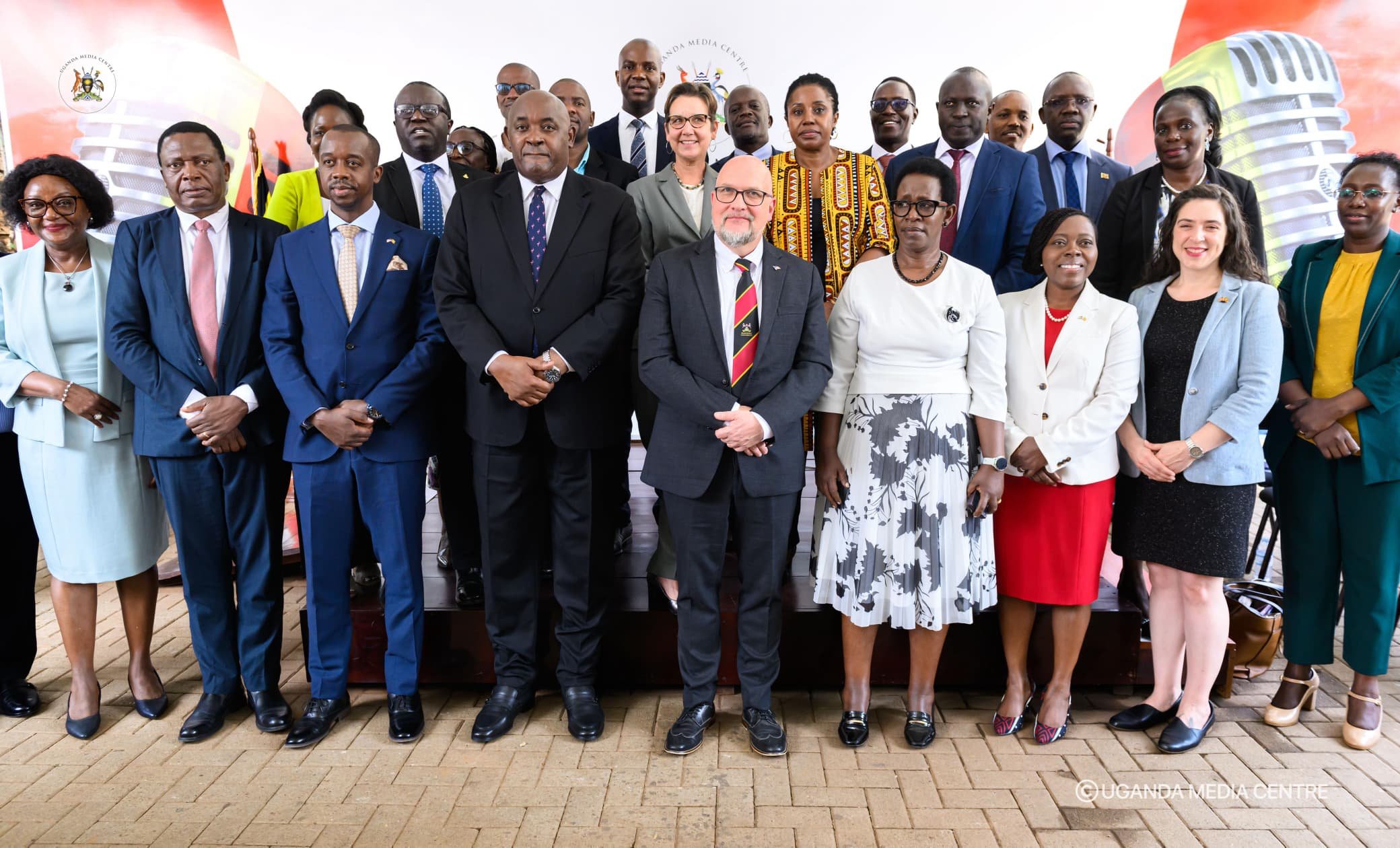
(Group photo) Ministry of Health officials together with partners at the release of UPHIA 2025 preliminary results at the Uganda Media Centre.
Nearly every Ugandan who knows they are living with HIV is on treatment and virally suppressed, but about one in seven people living with the virus still do not know their status. That is the central message from the preliminary results of the 2025 Uganda Population-based HIV Impact Assessment (UPHIA 2025), released today by Health Minister Hon. Dr Chris Baryomunsi at the Uganda Media Centre.
The survey, conducted between July and September 2025, puts adult HIV prevalence (15 years and older) at 5.9 percent — 7.3 percent among women and 4.1 percent among men, essentially unchanged from the 2020 survey. This translates to roughly 1.5 million adults living with HIV. Among those of reproductive age (15–49), prevalence stands at 5.5 percent.
On the globally watched 95-95-95 targets, Uganda has made clear progress:
- 85.3 percent of adults living with HIV know their status,
- 99.1 percent of those who know their status are on antiretroviral therapy (ART), and
- 96.5 percent of those on ART are virally suppressed.
Overall, 86 percent of all adults living with HIV — regardless of whether they know their status have suppressed viral loads, up from 75.4 percent in 2020. The Minister described this as evidence that treatment programmes are reaching most people living with HIV and delivering results.
“About one in seven people living with HIV do not know their status,” Dr Baryomunsi said. Closing that gap, he stressed, is now the critical priority if Uganda is to end AIDS as a public health threat by 2030.
Regional and demographic differences are stark. Prevalence ranges from just 1.3 percent in the North-East (Karamoja) and 1.4 percent in West Nile to 8.0 percent in the South-Western region. Among young people aged 15–24, prevalence is 1.5 percent overall, but twice as high among young women (2.0 percent) as among young men (1.0 percent). Prevalence jumps nearly threefold between the 15–19 and 20–24 age groups for both sexes, while viral load suppression is markedly lower among younger adults.
UPHIA 2025 also collected data on non-communicable diseases. Elevated blood pressure was found in 15.5 percent of adults, elevated blood glucose in 0.9 percent, and overweight or obesity in 24.8 percent — figures the Minister said reinforce the need to integrate HIV services with hypertension, diabetes and other chronic care within primary health care.
The survey was conducted by the Ministry of Health in collaboration with Makerere University School of Public Health, the Uganda Bureau of Statistics, the Uganda Virus Research Institute, and regional and district teams, and was funded by the U.S. President’s Emergency Plan for AIDS Relief (PEPFAR) through the Centers for Disease Control and Prevention. Participation was high: 94.4 percent of eligible households and over 91 percent of eligible adults took part.
Dr Baryomunsi framed the results as both an accountability tool and a practical guide for the next phase of health reforms. With external financing under pressure, he said, the evidence will help government protect gains, target resources where the gaps are greatest, and advance integrated service delivery under universal health coverage.
He called on every Ugandan to know their HIV status, use prevention services and start treatment promptly if diagnosed; on district leaders and health workers to use the data for planning and performance review; and on partners to align support with government priorities for a sustainable, country-led response.
Dr Diana Atwine, Permanent Secretary, Ministry of Health, reacted to the released results, saying they accurately reflect HIV in Uganda and give the Ministry of Health and Government a roadmap for what needs to be done.
A fuller report, including incidence estimates, programme coverage and behavioural indicators, will be released later. For now, the preliminary findings deliver a clear verdict: Uganda’s treatment programme is performing strongly, but finding the remaining undiagnosed — especially young people and those in higher-prevalence regions — is the unfinished business that will determine whether the country stays on course to end AIDS by 2030.