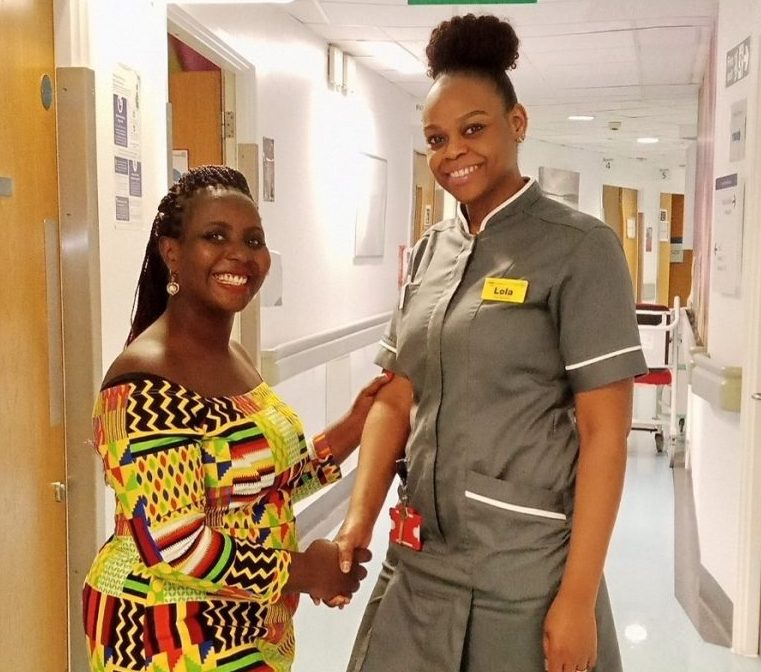
While attending the UK-Africa Health Summit at the Royal College of General Practitioners, Euston, from 18th to 19th March 2024, after the summit, I took time to visit some of the NHS trusts/hospitals in the UK, and one of the hospitals I visited was Queen’s Hospital.
The reason for the visit was my desire to attach sight to the sang beauty of midwifery care practiced in developed continents like Europe. I also sought to benchmark and make a facsimile of the best practices in Europe and transfer them to my home country, Uganda, for better outcomes for mothers and their babies.
While at Queen’s Hospital, I was warmly welcomed by Ms Lola Enifeni, a Global Health Policy Specialist and Matron for the Labour ward. During my visit, I observed key areas that I felt lacked back home and should be considered by government and they included the following; On average, the hospital conducts 20-25 normal deliveries on a daily, a shift runs for 7.5 hours, each shift consists of 13 registered midwives, 03 maternity support workers and 2 obstetricians, each labouring woman is taken care of by one midwife, thus a ratio of 1:1, low risk women i.e without complications deliver from the birth centres within the hospital, and experience a homey kind of environment, with only midwives, the birth centres are spacious, tidy with water pools, birthing balls, delivery beds and stools, wireless CTG, Doppler and many others, high risk mothers go straight to the Labour ward, data is entered electronically via intranet,l abour ward dashboard is updated on a daily and has a component of patients;’ experiences, hospital acquired infection, complaints, ward acquired pressure ulcers and medication on-top of the usual, the hospital has emergency kits for managing emergency conditions like, severe preeclampsia and eclampsia, postpartum haemorrhage etc, for each procedure or condition to be managed, one must follow the guidelines or protocols in place, short of that, one will need to justify why or even face legal implications. All protocols are available on intranet e.g. protocol for spontaneous vaginal delivery, breech delivery, twin delivery, shoulder dystocia, caesarean section, eclampsia, etc, a maternal or neonatal death is barely heard of, common pregnancy complications in this hospital include hypertensive disorders e.g. preeclampsia and eclampsia, postpartum haemorrhage is a rare complication for mothers after deliver, first line for management of 3rd stage of labour (use a mix of oxytocin and ergometrine) for non hypertensive women, 5Ius, labouring mothers are monitored using a doppler or wireless CTG to allow movements freely during labour, they have a central monitoring point on top of the individual room monitoring for each mother. This helps the supervisors or experts to identify any unnoticed gaps during the labour monitoring process. The minimum education level for a midwife is 3 years (without research). A bachelors’ in midwifery is 3years too but with research, emergency response teams are well set, and everyone undergoes mandatory training in this, patients are number one priority, and any concern from a patient is a big concern and must be highly critiqued, hospital has free WIFI accessible to everyone, mothers whose babies die after delivery are isolated, and put in a separate room and provided care, health workers such as midwives have good customer care, midwives have up to date knowledge, skills and always willing to share with others, maternity care providers receive continuous professional development (CPDs) sessions every 03 months, guidelines/protocols in use are updated every 03 years, however, whenever new developments or evidence emerge, the team is informed timely, respectful Maternity care is paramount, teamwork is key.
With the above observations, I was greatly challenged, especially when I compared them with our healthcare setting and care provided to our patients here in Uganda. I vowed to contribute to better maternity care in Uganda.
The author is: BSc Nurse & MSN-Midwife & Women’s Health Specialist & Heroes in Health Award-winning Midwife.