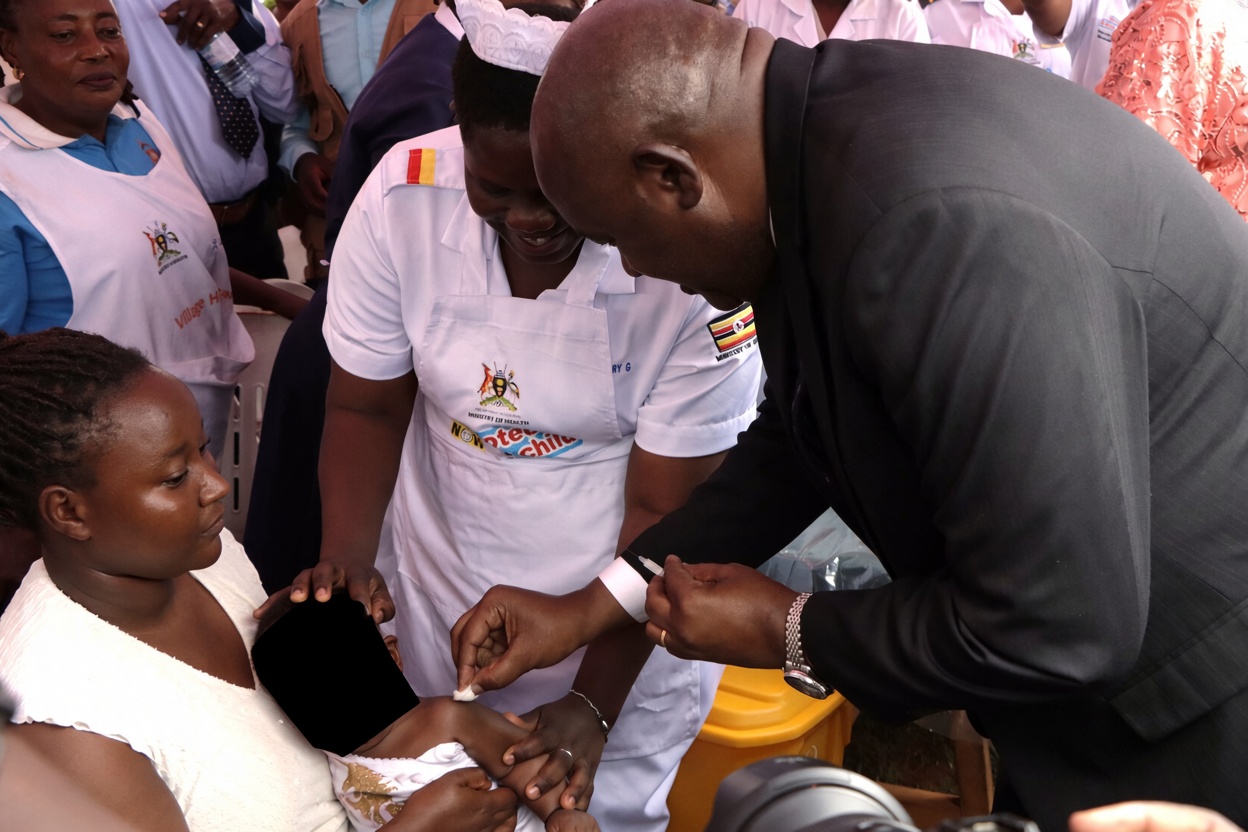
Minister of Health Dr. Chris Baryomunsi vaccinates a child at Wakiso Health Centre IV during the nationwide Measles-Rubella Vaccination Campaign.
Dr. Charles Olaro, Director General of Health Services at the Ministry of Health, has asked health workers to be receptive to parents and cautious during the Measles & Rubella Vaccination Campaign.
“I thank health workers for the work you are already doing, and that you will do over the five days. I ask you to welcome parents, listen to their questions, and give them clear and accurate information,” Dr. Olaro said.
“Make every effort to reach every child wherever they are, including those in hard-to-reach communities. Most importantly, let us vaccinate every child safely and ensure that the vaccine is properly recorded,” Dr. Olaro added.
He made these remarks during the launch of a five-day nationwide Measles-Rubella vaccination campaign in Wakiso District at Wakiso Health Centre IV. The campaign aims to close critical immunity gaps and curb ongoing outbreaks of the highly contagious disease.
The campaign will run from 1st to 5th October 2026 and targets all children aged 9 months to 5 years, including those in refugee communities, regardless of previous vaccination status.
Speaking at the launch, Minister of Health Dr. Chris Baryomunsi highlighted that the campaign is timely. He noted that despite an improvement in the uptake of the first dose to 92% in 2025, coverage for the second dose given at 18 months stands at only 64%. This has left a substantial number of children susceptible to infection.
Dr. Baryomunsi stressed that measles remains a highly contagious and potentially deadly disease, especially among unvaccinated and under-immunised children. Although Uganda’s overall measles vaccination coverage rose from 79% in 2016 to 90% in 2024, it still falls short of the 95% threshold required to interrupt transmission and prevent outbreaks.
“The current situation demonstrates that coverage alone is not enough; we must ensure that every child receives all required vaccines and completes the vaccination schedule,” the Minister stated. He emphasised that high immunisation levels create herd immunity, acting as a communal shield that denies the measles virus the opportunity to spread.
He further asked the public to disregard misinformation about immunisation and reiterated that the vaccines for all 14 diseases covered by the programme are safe.
“I have children, and my children are fully immunised, so if I knew that the vaccines have a problem, would I have immunised my children?” the Minister asked.
“As the Ministry of Health, we are in charge of the health of Ugandans; we cannot promote anything harmful to Uganda. I have been told that there are some religious sects in some parts of the country that campaign against immunisation. They are wrong because they are misled and misinformed,” Dr. Baryomunsi said.
“Actually, if you campaign against immunisation, you are promoting death,” Dr. Baryomunsi added.
Dr. Diana Atwine, Permanent Secretary of the Ministry of Health, appreciated the work done by Community Health Workers (CHWs), Village Health Teams (VHTs) and health workers in the fight against diseases such as malaria. She encouraged them to show the same commitment during the Measles & Rubella vaccination campaign.
“If it were not for you, we would not have reached all the homes that you have been able to reach,” Dr. Atwine said.
The government’s longer-term priority remains strengthening routine immunisation so that children receive their vaccines on schedule and population immunity is sustained at levels that prevent future outbreaks.
The campaign forms part of Uganda’s continued commitment to the Uganda National Expanded Programme on Immunisation (UNEPI), first launched in 1983 and relaunched in 1987. The programme has expanded from protecting against six killer diseases to covering 14.
According to reports from the Ministry of Health, in 2025, 66 districts reported confirmed measles outbreaks, resulting in more than 10,163 cases and 60 deaths. Since January this year, outbreaks have been confirmed in 20 districts, with 12 measles-related deaths recorded.
Investigations by technical teams attribute the outbreaks to several interconnected factors: gaps in immunisation coverage (children missing doses or receiving only one of the two recommended doses), difficulties reaching remote populations, vaccine misinformation and hesitancy, weaknesses in surveillance, delayed care-seeking, varying outbreak-response capacity at district level, and severe malnutrition, particularly in the Karamoja region, which has contributed to higher mortality among affected children.