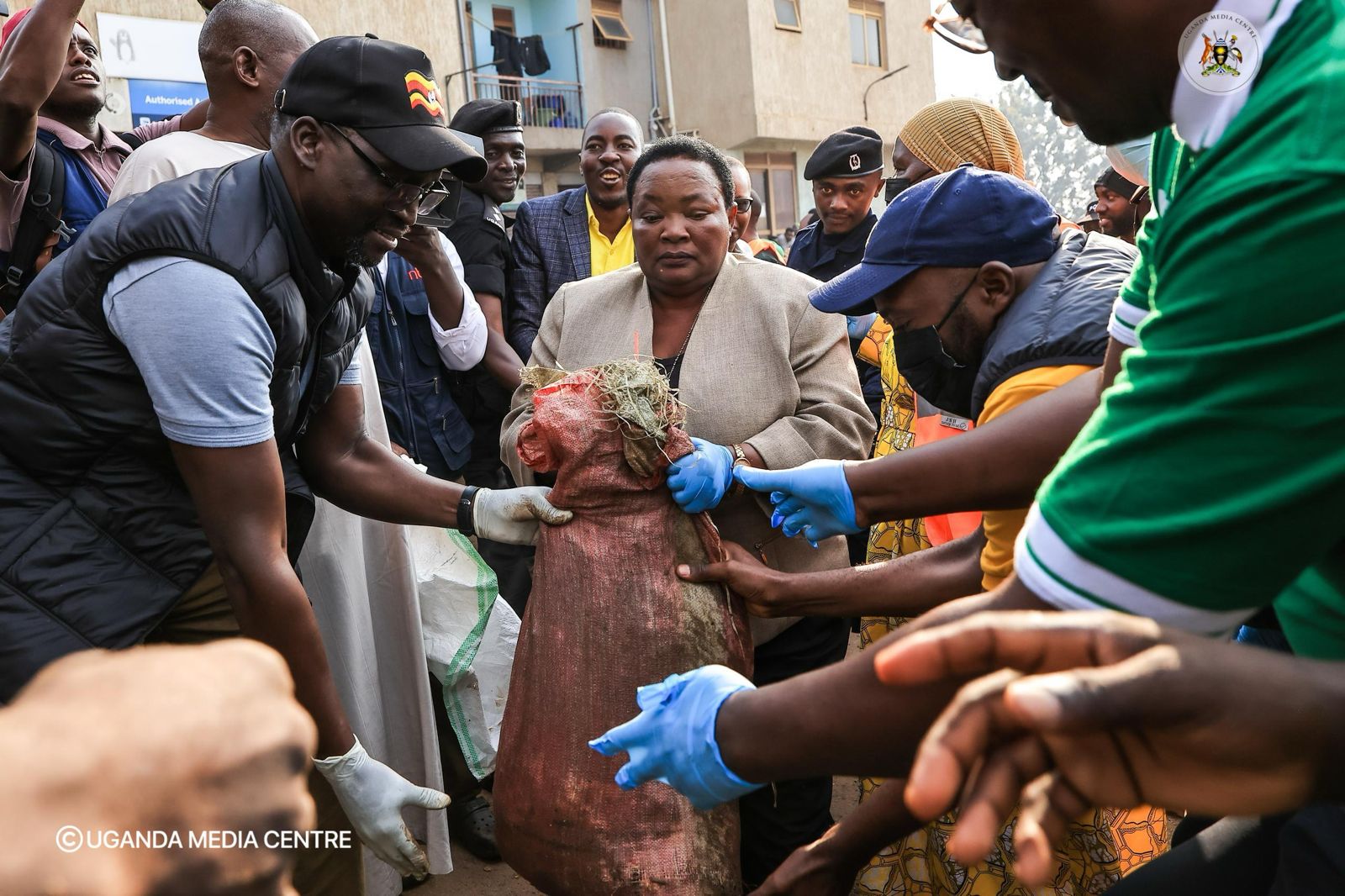
Prime Minister Rt. Hon. Robinah Nabbanja (centre) lifts a sack of garbage during the Launch of the National Cleaning Days Initiative in Kisenyi, Kampala.
Govt Rolls out Mandatory National Cleaning Days to Address Public Health Concerns
The Government has launched the National Cleaning Days Initiative, a nationwide campaign aimed at promoting cleaner, healthier, and more productive communities in response to growing public health concerns.
The initiative, which will be observed on the last Saturday of every month from 7:00 a.m. to 10:00 a.m., was officially launched on Saturday in Kisenyi, Kampala, by Vice-President Jessica Rose Epel Alupo, representing President Yoweri Kaguta Museveni.
The campaign calls on all Ugandans to take an active role in keeping their homes, workplaces, schools, markets and public spaces clean as part of a collective effort to improve public health, reduce preventable diseases and support the country’s socio-economic transformation.
Speaking at the launch, Vice-President Alupo said Uganda remains committed to accelerating its transition to middle-income status by promoting healthy, productive and dignified living conditions for all citizens.
She said a clean and healthy environment is fundamental to achieving this goal, noting that Cabinet approved the National Cleaning Days Initiative to empower communities to take greater responsibility for their health by addressing the social determinants of health.
The Vice-President urged Ugandans to embrace cleanliness, warning that dirty homes, streets, markets, schools, places of worship and workplaces expose communities to preventable diseases. She called upon religious and cultural leaders, political leaders, Resident District Commissioners, local governments and the youth to champion the initiative.
“Poor waste segregation, irresponsible waste disposal, inadequate waste management practices and irregular cleaning of our surroundings are not optional; they are issues that require collective responsibility and patriotism,” she said.
Alupo said the monthly exercise would strengthen communities, reduce preventable diseases, lower catastrophic household health expenditure, enhance productivity and contribute to improved household incomes and national development.
The Office of the Prime Minister will coordinate the National Cleaning Days Initiative in collaboration with relevant Ministries, Departments and Agencies. The Ministry of Health will serve as the lead technical ministry, working alongside the Ministries of Water and Environment, Local Government, ICT and National Guidance, Gender, Labour and Social Development, Education and Sports, Defence and Veteran Affairs, Internal Affairs, among others.
Prime Minister Robinah Nabbanja said the initiative would improve public health, reduce the burden of preventable diseases and lower both household and government expenditure on treatment while contributing to cleaner and more productive communities.
“Its slogan, ‘A Clean Uganda Is Everybody’s Responsibility’, reminds us that cleanliness is a shared duty. If we all embrace this message, we will become agents of positive change and help foster a culture of cleanliness across our communities,” she said.
She urged the Ministries of Health, Water and Environment, Local Government, ICT and National Guidance, the Kampala Capital City Authority (KCCA), and other government agencies to ensure effective planning and coordination to successfully implement the programme.
Minister for Health Dr Chris Baryomunsi said the initiative, which began on Saturday, will now be observed on the last Saturday of every month across the country.
He said the Government’s decision was informed by the high prevalence of preventable illnesses, noting that about 75 per cent of diseases affecting Ugandans could be avoided through improved sanitation, hygiene and environmental cleanliness, citing malaria as one example.
“75% of diseases in Uganda are preventable, meaning we can do something to avoid or prevent that illness and a number of them have everything to do with hygiene and related issues,” the health minister said.
According to the World Health Organisation, Uganda recorded over 16 million cases of malaria and 2793 deaths in 2023 alone.
Addressing enforcement concerns, Dr Baryomunsi said the success of the programme would depend more on public ownership than policing.
“We should not focus on the police or security agencies to enforce this. The first people to enforce it are ourselves as Ugandans. What is important is that we appreciate why we must keep our environment clean,” he said.
He urged Ugandans to treat the monthly exercise seriously by joining their communities to clean their surroundings between 7:00 a.m. and 10:00 a.m. on the last Saturday of every month.
Dr Baryomunsi stressed that National Cleaning Day should not be viewed as the only day for maintaining cleanliness but as a nationwide mobilisation to cultivate a lasting culture of environmental hygiene.
“The way we are mindful of bathing our bodies every morning, we are also saying we should bathe Uganda. Every day we should keep our surroundings clean, but on the last Saturday of every month, the whole country should come together to clean our environment,” he said.
He added that sustaining a culture of cleanliness would help reduce diseases such as malaria by eliminating mosquito breeding sites and improving sanitation, ultimately contributing to a healthier and more productive Uganda.