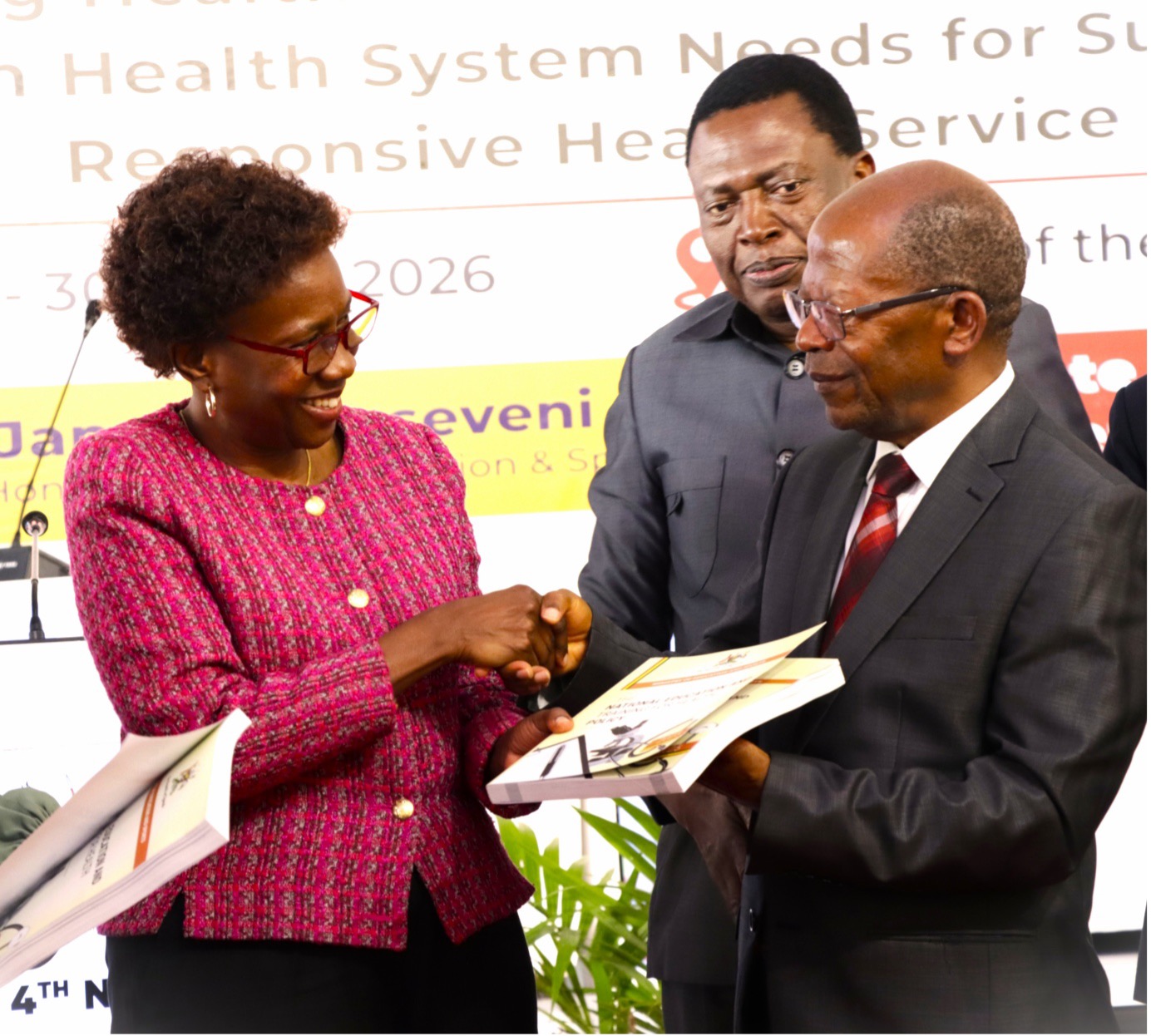
L-R: Dr Jane Ruth Aceng, Health Minister; Dr. Charles Olaro, Director General, Health Services; Hon. John Chrysestom Muyingo, State Minister for Higher Education, during the launch of the National Education and Training for Health Policy on April 29, 2026, in Jinja.
Ministry of Health Attributes Underperformance in Health Facilities to Leadership Gaps
On April 29, 2026, during the 4th National Health Professional’s Education, Training and Healthcare Conference in Jinja, Dr. Charles Olaro, the Director General of Health Services at the Ministry of Health, said that ineffective leadership in health facilities has led to underutilization of resources, staff underperformance, underutilization of equipment, and wastage of resources.
“A well-led facility with modest resources but with good leadership can perform better than a facility with a lot of resources but with poor leadership,” Olaro said.
Dr. Olaro further stated that for any health facility performing well, there is a leadership story behind it, and vice versa. He cited the example of a health facility in Kalenga that was underperforming due to the transfer of the District Health Officer (DHO).
According to Dr. Olaro, poor leadership in health facilities undermines government efforts to improve health service delivery.
“Because of the leadership gaps, the infrastructure built by the government is left redundant, resources are wasted, and it is the same reason you find a health facility with two doctors, but there is no operation taking place.” Dr. Olaro said.
He further stated that even with the best workforce, ineffective leadership affects service delivery because leadership turns policy into practices and resources into results.
According to Dr. Olaro, the lack of leadership among health professionals stems from the nature of their training, which focuses on scientific reasoning, clinical judgment, and technical skills, but rarely prepares them for leadership and management.
“Many of us find ourselves managing departments, hospitals, and projects without leadership skills, but a few can navigate the system successfully. For better outcomes, we should not leave the development of health leaders to just chance,” Olaro said.
Dr. Olaro further urged health training institutions to teach students about leadership while they are still in training so they can become better health leaders in the future.
At the 4th National Health Professional’s Education, Training and Healthcare Conference, where these remarks were made, the Ministry of Health and the Ministry of Education and Sports launched the National Education and Training for Health Policy. Dr Olaro said that once implemented, the policy will address the leadership gaps.
The National Health Professional’s Education, Training, and Healthcare Conference is an annual event organized by the Ministry of Education and Sports. It brings together health trainers, regulatory bodies, practitioners, and other stakeholders in the health sector to discuss best practices for better health service delivery.